For most of my life, I believed in the American Dream. Work hard, make money, buy the house, then buy a better house. Drive the expensive car. Build a successful business. Become successful enough that other people know you are successful. Sound familiar?
I certainly wasn’t alone. We are surrounded by messages telling us what success is supposed to look like. The cars, the houses, the vacations, the clothes, the right address. Today, social media has taken “keeping up with the Joneses” to an entirely different level. Everywhere we look, someone seems to have more, and we are constantly being reminded of what we don’t have.
I bought into it, and I became very good at it.
I built successful businesses and made millions of dollars. I owned mansions and expensive cars, traveled on private jets, and rubbed elbows with celebrities and politicians. From the outside, I had achieved the American Dream. By almost every measure I had been taught to use, I had made it.
The problem was that I wasn’t happy, and for a long time I couldn’t understand why.
I Had Confused Riches with Wealth
This took me decades to understand. There is a difference between being rich and being wealthy.
I used to measure wealth primarily by financial success. How much was I making? What did I own? How successful was the business? What could I afford? The more successful I became, the more my identity became attached to those things.
I had created an image of success, and somewhere along the way, that image became more important than the person underneath it.
Then life gave me a brutal education. After the 2008 financial crisis, I went through financial and legal problems that shook the foundation of everything I had built. Because so much of my identity was tied to money and success, when those things were threatened, I felt threatened too.
My net worth had become my self-worth.
That is something I wish I had understood much earlier in life. Riches are not the same thing as wealth, and happiness is not the same thing as fulfillment. You can have a tremendous amount of money and still be missing something incredibly important.
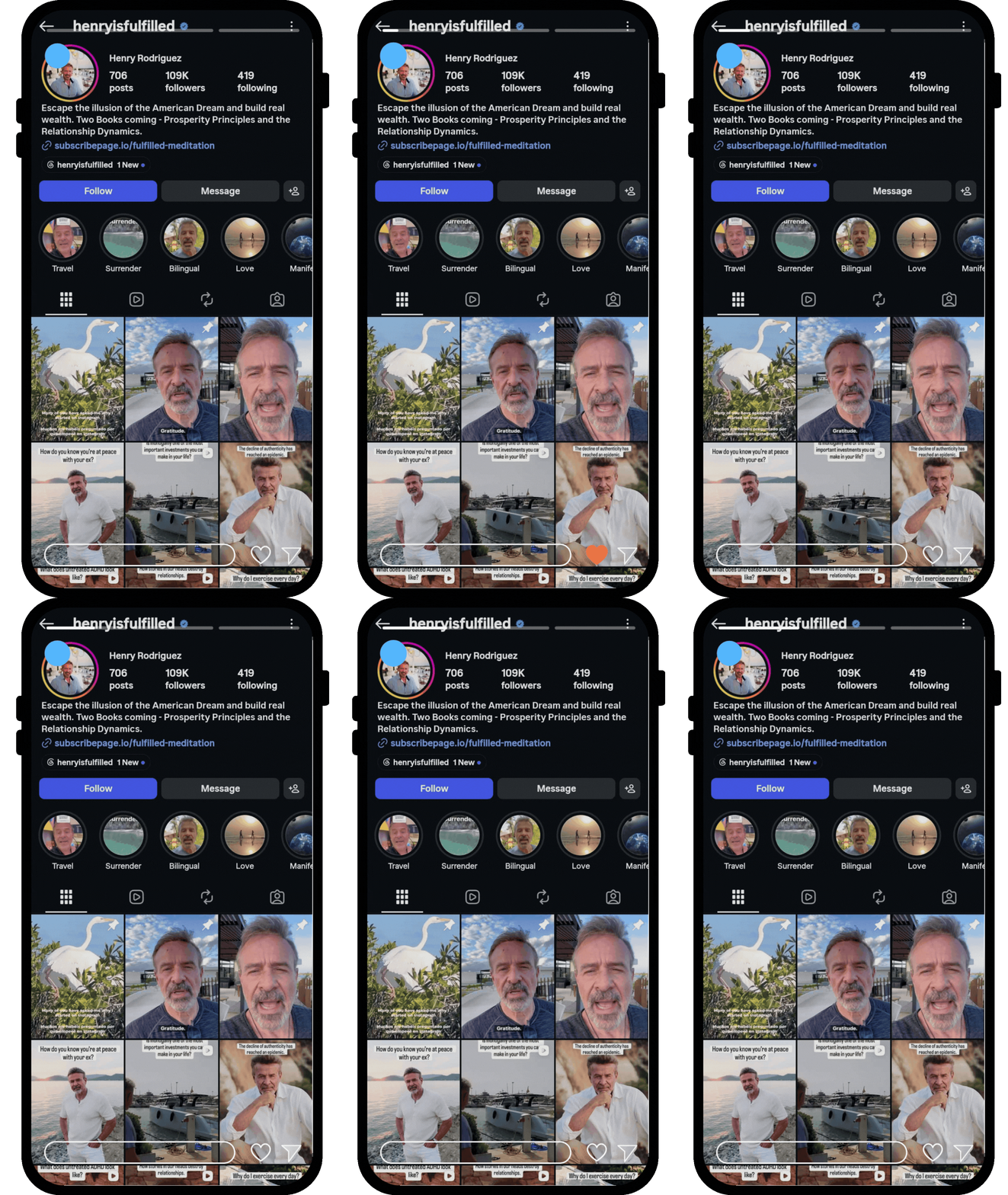
Meet Henry Rodriguez — @HenryIsFulfilled
Henry explores what it really means to live a fulfilled life beyond money and achievement. Through his work, he shares insights on purpose, personal growth, and finding balance across the spiritual, physical, mental, and financial sides of life.
What Is the American Dream, Anyway?
Think about that question for a minute. What does living the dream mean to you?
Is it a million dollars? Ten million? A Ferrari? A beautiful home? Being able to retire at fifty? Traveling around the world?
There is nothing wrong with wanting any of those things. I still enjoy beautiful things, and I am certainly not going to tell you that money doesn’t matter. Of course it matters. Money can give you safety, choices, the ability to take care of your family, travel, invest, give generously, pursue your passions, and have more control over your time. Most importantly, money can give you freedom.
What money cannot do is determine your worth as a human being. That was something I had to learn the hard way.
As a young man, I wanted the sports car, the mansion and the big bank account. I wanted achievement and significance. At the time, I would have told you I was doing it for myself and my family, and that was certainly part of it. Looking back, however, I can see there was something else underneath all of that ambition.
I wanted to prove I was worthy.
Have you ever bought something because of the way you thought it would make you feel, or because of what you thought it would say about you? Be honest with yourself. I have.
The Dream We Were Sold
For generations, we have been conditioned to associate possessions with success. Social media has simply made that conditioning harder to escape.
You see somebody driving a Bentley or Ferrari. What happens inside you? Maybe you admire them. Maybe you’re envious. Maybe you immediately start thinking about what it would take to own one yourself. Maybe you couldn’t care less. There isn’t necessarily a right or wrong answer, but it’s worth paying attention to your reaction because it may tell you something about your own relationship with money and success.
Someone will always have a bigger house. Someone will have a newer car. Someone will be flying somewhere you aren’t. Someone will make more money than you do. If your definition of success depends upon comparing yourself with everyone around you, when exactly do you get to say, “I have enough”?
For me, the finish line kept moving. The more I achieved, the more there was to achieve.
I eventually had to ask myself what all of this was actually for.
My Definition of Wealth Changed
Today, I look at wealth very differently. I believe a prosperous life requires balance in four areas: financial, mental, physical and spiritual. I call these the Four Pillars of Prosperity.
One of the easiest ways I can explain this is to imagine your life as a chair. A chair with four strong legs doesn’t require you to constantly think about staying upright. You can sit comfortably, move around, talk to the people around you and enjoy yourself without worrying that you’re going to fall over.
I spent much of my life trying to balance on one leg, the financial one. I became extraordinarily successful financially, but I eventually discovered that one strong pillar couldn’t compensate for what was happening in the other parts of my life.
What good is financial success if you are too unhealthy to enjoy it? What good is a beautiful home if you cannot find peace while sitting inside it? What happens when your business is thriving but your mind never shuts off? And if your entire identity is tied to being successful, who are you when success is suddenly taken away?
These aren’t theoretical questions for me. I had to face them in my own life.
Maybe the American Dream Isn't Dead
I don’t believe we need to abandon the American Dream. I think we need to decide for ourselves what the dream actually means.
A teacher who loves what she does and changes the lives of her students may be living her dream. A firefighter who finds tremendous purpose in saving someone’s life may be living his. An entrepreneur who builds a successful company while still having time for family, health and the things that give life meaning may have found exactly the kind of success he or she wanted.
And yes, someone who starts with almost nothing and becomes a multimillionaire can absolutely be living the dream too.
The amount of money isn’t the point. What matters is whether the life you are building actually belongs to you.
Are you pursuing something you truly want, or something you were taught to want? Is the money giving you greater freedom, or are you working harder and harder just to maintain everything you’ve accumulated? Are you healthy enough to enjoy what you’ve built? Do you have relationships that mean something to you? Do you have peace? Is there a greater purpose behind what you are doing?
Those questions matter a lot more to me today than what is parked in the driveway.
It took me decades, enormous financial success, tremendous losses and a lot of unnecessary pain to understand that. I wish I had understood it much earlier.
So perhaps the question isn’t whether the American Dream still exists. Perhaps the question is much more personal.
Whose dream are you chasing?
If the answer isn’t yours, maybe it’s time to start creating one that is.
A New Definition of Prosperity
In my upcoming book, Prosperity Principles: The Four Pillar Plan to Freedom, I share my successes, my mistakes, and the lessons that completely changed the way I think about money, health, mindset, spirituality and what it means to live a truly wealthy life.
If you’re ready to create your own definition of success and build a life with both wealth and fulfillment, I invite you to join the waitlist.
